
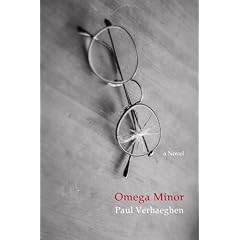
I’ve just finished reading Omega Minor by the Belgian novelist Paul Verhaeghen, a cognitive psychologist now working in the States. Originally published in Dutch, this enormous novel – 700 pages of closely-printed text – was translated into English by its author, winning the Independent Foreign Fiction prize in the process. The English, like the novel itself, is constantly inventive, and slightly quirky; Verhaeghen has stated that he decided to do the translation himself after seeing the lamentable job a professional translator had done of a section of the book, and I can well believe it. It isn’t a job I’d have taken on willingly, and certainly not at the rates a work this size inevitably attracts if it’s to exist at all. It’s a sprawling, superficially confused, engagingly unwieldy sort of book that resists unity of style, that resists, in many ways, any kind of unity at all, except that provided by its existence as an attractive, slightly austere, well-made physical artefact, for which we have, once more, the Dalkey Archive to thank.
The narrative arc of the novel covers much of the last century, with key events clustering around the opposing poles of the Second World War and the destruction of the Berlin wall. Geographically, its heart is Berlin, although long sections are set in New York and Los Alamos, and one short section in an improbably glamorous Bath, a place I suspect Verhaeghen has never seen. It’s a book that barely acknowledges a world beyond that defined by mid-twentieth century Europe and the post-war diaspora, except – in the case of Japan – as a target for the nuclear bomb. There’s no reason why it should. It has more than enough on its plate as it is.
The novel opens with a description of a sexual encounter that sets the tone for most of the sex in the novel. There isn’t that much of it in terms of pages, but what there is shares a relentless, near-pornographic quality that might have something to do with Verhaeghen’s not being a native speaker. It’s a strange amalgam of the poetic, the urological and the simply weird, as in this extract from the second page:
Behold the purple head that sways so swiftly on its heavy stalk; see how it glistens with her spit and juices; watch the little crater at the top spit out its zigzag line—out shoots the slime, the whirling weathervane, the drunken comet that climbs past the stars: In the moist cloud chamber of Donatella’s room, a signal lights up in silvery white, an almost perfect circle described by the tumbling ribbon of spunk, an acrobatic snake snapping at—but missing—its own tail: an ancient Greek symbol, the latter Omega, capitalized—Ω.
This opening scene does more than establish the tone and central elements of the novel’s theme. Crucially, the sexual act is being described not by a protagonist, but by someone who observes, himself unobserved. The novel is deeply concerned with what it means to be a witness, and with the kind of power, and lack of power, this involves. It goes beyond this to question the nature and permeability of the boundaries we draw between those who act and those who watch, and how historical and personal blame should be apportioned between these two groups, taking into account the extent to which any distinction made between them might be facile, or false. Dangerous ambiguities are evoked as the novel progresses – through confession and dissimulation – and even the aphoristic moral certainty of such a sentence as “There is a world of difference between an act that is permitted and an act that is permissible” is undermined by what the novel does.
Omega Minor is designed to be seen as a book that works on multiple levels. Its refusal, for example, to utter the word God, preferring G*d, suggests that it sees itself as a sort of holy text, as one that runs the very real risk of blasphemy, or, alternatively, as a text that denies God and demonstrates its denial on the page. The action jumps, often irritatingly, from one time and place to another, often without identifying the central character or narrative viewpoint, leaving the reader to flounder for a page or two and sometimes, when a new character is introduced without warning, for considerably longer. It draws on religion, and history, both personal and political, and science both as bodies of fact and as sources of metaphor, as though there really were a mystery at the heart of things that might be revealed. Which mystery, in the end, is what provides the novel with its – for me –unsatisfactory climax. The novel’s over-written at times, and under-imagined at others, particularly when it talks about love, and I found it hard to care for anyone other than the one person who perhaps deserved it least. At the same time, and despite these misgivings, I found the book deeply absorbing, and the time spent reading it time well spent. If what I was left with was a very traditional sense of the sheer awfulness of its material, for want of a better term, rather than a new understanding of the way in which the material is being reworked, by history and time, by deniers and apologists, this didn’t detract from the very powerful impact the book made on me. It’s not damning with faint praise but its diametrical opposite to say that this book is over-ambitious. I recommend it.



 CHARLES LAMBERT