
Twitter Updates
Tweets by charles_lambert-
Recent Posts
Archives
- February 2021
- January 2021
- August 2018
- September 2017
- May 2017
- February 2017
- January 2017
- March 2016
- February 2016
- December 2014
- November 2014
- October 2014
- September 2014
- August 2014
- March 2014
- December 2013
- November 2013
- October 2013
- September 2013
- July 2013
- June 2013
- May 2013
- April 2013
- March 2013
- February 2013
- November 2012
- October 2012
- July 2012
- April 2012
- January 2012
- December 2011
- November 2011
- October 2011
- September 2011
- August 2011
- June 2011
- May 2011
- April 2011
- March 2011
- February 2011
- January 2011
- December 2010
- November 2010
- September 2010
- August 2010
- July 2010
- June 2010
- May 2010
- April 2010
- March 2010
- February 2010
- January 2010
- December 2009
- November 2009
- October 2009
- September 2009
- August 2009
- July 2009
- June 2009
- May 2009
- April 2009
- March 2009
- February 2009
- January 2009
- December 2008
- November 2008
- October 2008
- September 2008
- August 2008
- July 2008
- June 2008
- May 2008
- April 2008
- March 2008
- February 2008
- January 2008
- December 2007
- November 2007
- October 2007
- September 2007
- August 2007
- July 2007
- June 2007
- May 2007
- April 2007
- March 2007
- February 2007
- January 2007
Categories
Meta
-
Join 274 other subscribers
The (new) emperor’s new clothes
Posted in berlusconi, election, italy, politics
7 Comments
Power of the press
Well, I hadn’t realised the Sunday Telegraph would have such impact in a provincial Italian town.I’d decided to keep pretty quiet about the piece I wrote on Fondi a few weeks ago, on the grounds that the information wasn’t there to boost local egos but to help people who didn’t know the place to enjoy themselves here. I point out some of the most attractive places to visit, best places to eat, the usual stuff. I also point out that one of the town’s restaurants is a place to be avoided ‘unless you like being told what to eat by the owner’. I could have said a lot more about this particular place: that the food is over-priced, that the owner treats his customers with contempt, that he refuses to provide a menu, something required by Italian law, and laughs at people who ask for one. I could have, but I didn’t.
I suppose it’s foolish to expect anonymity when your name and photograph appear beside the article, so I wasn’t surprised when some of the people mentioned started to ask for copies. But I didn’t expect to hear that the owner of the offending – and now offended – restaurant was threatening to have me driven from the town, as though it were his personal fiefdom. This is a typically anti-democratic reaction to acts of lèse majesté, so if I’m kneecapped (or disappeared) in the next few weeks, you’ll know who to blame.
Posted in fondi
2 Comments
Penelope Fitzgerald
 Penelope Fitzgerald’s cropped up twice these past few days. Once on a just-read March 5 post from the House of Mirth, which posted this wonderful short letter she wrote to a bookseller who thought she might be interested in buying some books on Cairo. A second time in the Guardian, in an interesting article by Rachel Cooke about the essential role played by Virago in her literary education, a judgement I wholeheartedly endorse. She writes:
I once asked a famous British novelist who he regarded as the great post-war 20th-century novelist, and when he said ‘Penelope Fitzgerald’, even I – very shaming, this – was temporarily flummoxed.
I don’t know who the famous British novelist is (any ideas?), but I agree with him. So it’s very good news that her letters are due out in May, from Fourth Estate, as So I Have Thought of You: The Letters of Penelope Fitzgerald.
Posted in penelope fitzgerald
Leave a comment
Bella Ciao
Twenty years before the start of WW2, a Yiddish ballad was recorded in New York by a musician called Mishka Ziganoff. You can listen to it here. If you know the Italian partisan anthem, Bella Ciao, you’ll find parts of the ballad sound very familiar indeed. What isn’t clear is how they found their way from the ghettoes of the New World to the anti-fascist movement in Italy. Any ideas?
Posted in music
Leave a comment
Politometro
You have to live in Italy and speak Italian to get this. It’s one of those tests to see where you stand in the political spectrum. I’m the angry radio. The rest of them are politicians. If you’d like to see where you are click where it tells you to. (Cripes, I didn’t know it was going to be this big!)
The Guardian has a mildly optimistic leader today on the Italian elections this weekend. Its tone suggests that, even though we aren’t allowed to see the results of opinion polls in the two weeks preceding the vote, some people have and they’re suggesting a very close finish indeed. Things certainly haven’t looked that good for the PdL (translated, horribly, as Freedom Folk, and the product of cobbling-together Buffoon’s own party with the ‘ex’-fascist Alleanza Nazionale). Senator Marcello Dell’Utri, one of Berlusconi’s slimiest cronies commented that Berlusconi’s former stable-hand, a Mafioso sentenced to life imprisonment, was a ‘hero’ because he hadn’t spilled the beans on Berlusconi (yes, that’s what he said – think about it – he actually said that). Berlusconi – no longer media manipulator par excellence – also shot himself in the foot at a poorly attended rally in Rome when he said that Roma captain, Francesco Totti, must be off his head to vote for Veltroni. Not a wise move in a region that might prove decisive.
Things are looking good… Well, as good as they can, when the greater good is simply the lesser evil. After all, Veltroni’s PD is also the political home of Paola Binetti, self-flagellating bigot with the unusual leg jewellery.
Posted in berlusconi, bigotry, binetti, election, italy, politics
Leave a comment
Adventure
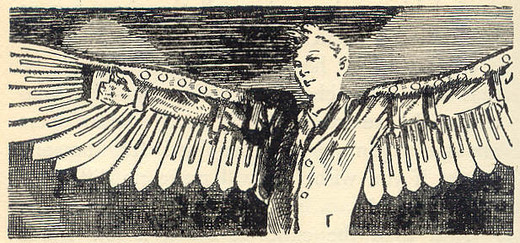 I was talking to an extremely well-read American friend and writer a couple of weeks ago and I discovered that not only had he never read Enid Blyton, he’d never even heard of her. OK, he’s younger than I am, but I’d never realised Blyton was such a British thing. Like most people of my generation, I devoured her books as a child, despite a growing climate of disapproval: her language was limited, her characterisation non-existent, her undercurrents of bondage and corporal punishment disturbing and potentially harmful. Some schools and libraries went so far as to ban her and I have a vestigial recollection of being looked at askance by a Lichfield librarian as I checked a Blyton out. I must have been six or seven.
I don’t remember ever much caring for the ones she wrote for the very young, like Noddy, but I have vivid memories of her re-working of the Pilgrim’s Progress, entitled The Land of Far Beyond, and of the Adventure series. This illustration, one of dozens produced by the extraordinary Stuart Tresilian for the series, comes from The Mountain of Adventure and has haunted me for years. I visited Lefkada some summers ago and discovered that, centuries before, the people on the island would sacrifice one of their number, usually a cripple or simpleton – known as the pharmakos, because his death, like medicine, was believed to heal the tribe. They’d attach wings to his arms and fling him from the cliff, the cliff from which Sappho also committed suicide, and I remembered this scene from the book; the scene and the illustration, as though they’d been waiting to be understood. I suspect that Blyton tapped into deeper veins than she was given credit for at the time. I think I’ll take a look at some of the books again. If you’re interested, The Enid Blyton Society seems to be a good place to visit.
Posted in enid blyton, reading
Leave a comment
Roof stuff
Last September, I posted a piece about the legal problems we were having with the roof of our house here in Fondi. It’s a long, and painful, story and if you don’t remember the details I suggest you click here.
(This is the point at which Patrick French yawns and moves on. Patrick French, for those who don’t read the Picador blog, has just published the first volume of a biography of Naipaul, an act of heroism on any level, and thinks that “Bloggers are bores; bores are bloggers. Have you ever read an interesting blog post? Neither have I. There are 100 million blogs on the Internet today, and 85 million of them are dead.” Right, Patrick.The thing about this kind of shallow wrong-headed comment is that it tempts me to write exactly the sort of blog post you’re talking about. So, fuck you, Patrick, here it is.)
Today, Giuseppe and I received a summons to appear in court for having broken the seals on the top floor of our house in order to cover it with a temporary roof. The seals don’t exist, of course, and never have. Like much of the law in Italy, they’re virtual and only there to be applied when someone remembers, or it suits someone’s interest, or there’s an ‘r’ in the month.
We don’t know what’s likely to happen until we speak to our lawyer tomorrow evening. In the meantime, I have to stop Giuseppe seeking out the vigile who wrote the report and ‘discussing’ the problem per strada. What I didn’t mention in my last post was that the vigile, a man who’s already been tried for corruption, offered me a sort of deal, and I was too stupid to realise. He said that his son wanted to study English at university and did I have any suggestions, anything that might smooth the boy’s path, a little help, as they say here. And I said: If your son wants to learn English he should avoid the Italian university system at all costs. With those rash but honest words, I sealed my doom.
Posted in corruption, fondi, italy, picador
Leave a comment
Punto e virgola
 Each culture gets the windbag it deserves. Italy has Pietro Citati, a man who imagines that, by writing about Kafka, Goethe, Proust, et al, he’s somehow earning his own place in the pantheon. What Citati doesn’t seem to have realised is that the weight of the flea and the weight of the dog aren’t just different, but on different scales.
He’s now turned his vacuous critical eye on an issue which doesn’t really concern him at all, except in a snobbish high-cultural way: the use of the semi-colon in English. I was in England when the poor thing’s imminent demise was announced in France, so I had the chance to read all the comments in the press. Apart from a woman who seemed to think that punctuation included just about everything, from grammar to register (I can’t remember who she was, or where she wrote; perhaps you can), most people were fairly sensible about the business, whether they cared or not (I’m a semi-colon fan, as you may have noticed). The general mood was that the world, and language, and literature, will survive. Interestingly, very few people seemed to know exactly what grammatical role it played; the general feeling was that it marked a longer pause than a comma, a shorter one than a full stop. It was actually fascinating to see how many writers see punctuation less as semantic than as a sort of musical notation. A mark of breath.
Citati, though, cares. He really cares. He says that the murder (sic) of the semi-colon is worse, far worse, than the murders we read about each day in our daily papers: the murders of husbands and wives, daughters and sons, cousins and great-aunts, second cousins and step-brothers, nephews twice removed and great-great uncles on the mother’s side (Citati loves accumulation; the longer the sentence, the easier it is to pop in a couple of semi-colons). People are nothing compared to that sexy combination of full stop, round, circular, plump, spherical (Citati loves synonyms) perched, hovering, poised, above the comma, caesura, curvaceous whatsit, er, punctuation mark. Who needs people? People aren’t culture.
He then has a go at academic language in Britain today. He doesn’t give any examples – why interrupt the flow? He simply complains that most sentences in Anglo-Saxon discourse these days are based on the three word structure of subject-verb-object. It would actually be quite hard to construct an argument on this basis, given that most English sentences also contain at least one article and an auxiliary verb, which would push the word count up to five or six. But what the hell. Citati isn’t just an artist; he’s a humanist. Even better, he’s an Italian humanist. He doesn’t need precision. It just has to feel good. It just has to make him look good.
He goes on to praise the Italian of today, by which he appears to mean his own, for its dignità, autorità and solennità, as if these qualities were somehow more valuable than precision or, horror of horrors, invisibility, by which I mean a language that doesn’t parade its finery or draw attention to itself. The problem with dignity, and authority, and solemnity is that they’re the kind of qualities that popes and warlords and emperors base their power on, not writers. Writers shouldn’t have, and shouldn’t need, new clothes. Citati should check his wardrobe, before it’s too late.
Posted in citati, language, semi-colon
Leave a comment
Pride
 Recognise this fat buffoon on the left? (Not Berlusconi, the one with glasses.) There’s no reason why you should unless you’re an Italian abroad and received some electoral bumph from his personalissimo party, Italiani nel Mondo – and, I hope, binned it as rapidly as possible. Either that, or you follow this blog with more attention than I deserve and recall him from a post some time ago, in which I described him as a smug bastard and gave a brief run down on his shameful – albeit shamelessly conducted – political career. His name is Sergio De Gregorio and he is, god help us all, a senator for at least the next five days.
He may not be quite so smug today because he’s being investigated for associating with the Calabrian Mafia. Apparently some plain-clothes policemen filmed him at a dinner during which he mediated for the powerful Ficara clan in their bid to buy an army barracks. Naturally, De Gregorio denies this and claims to be ‘disconcerted’ by the accusation. This is what most Italian politicians say when they’re caught with their fingers in the till. ‘I was just having a convivial meeting,’ he says.
He doesn’t seem in the least ‘disconcerted’ that he was having dinner with known Mafiosi in the run up to local elections. Why should he be? Berlusconi, his lord and paymaster, never is. And guess what De Gregorio’s giving him in the photograph above. Something called the Premio Orgoglio Italiano (Italian Pride Prize). You couldn’t make it up.
Posted in berlusconi, election, italy, mafia, politics
Leave a comment
Charlton Heston and, er, Morrissey
 Some of Charlton Heston’s reactionary political antics during the last few decades of his life probably warrant one of my Good Riddance posts, but that’s not all there was to the man. This photograph, taken in 1961, shows another, earlier, and more generous side to him. It comes from a nicely rounded Independent article, according to which the rot set in during his fifties. Let this be a warning to all those of us currently passing through that dangerous decade.
Apropos of reactionary viewpoints, Morrissey recently won a court apology from The Word, which had quoted him as complaining that Britain had lost its ‘identity’ as a result of immigration. As far as I know, Morrissey still lives in Trastevere, one of the oldest areas in Rome and occupied in large measure by immigrants. Not the kind people complain of when they pontificate about identity. The other kind. The rich, white kind that loves the Rome of Pasolini and Anna Magnani and style accessories like lines of washing overhead and parked Lambrettas. That this Rome no longer exists is due in no small measure to the presence of culture tourists like Morrissey, whose attachment to Italy is, I imagine, far less integrated than that of the hundreds of thousands of immigrants whose presence in Britain over the past forty years has not only ensured the functioning of essential services, but also contributed to creating its current ‘identity’.
How old is Morrissey?
Posted in death, politics, rome
Leave a comment
 CHARLES LAMBERT
